

Yeager's NF-104 Crash
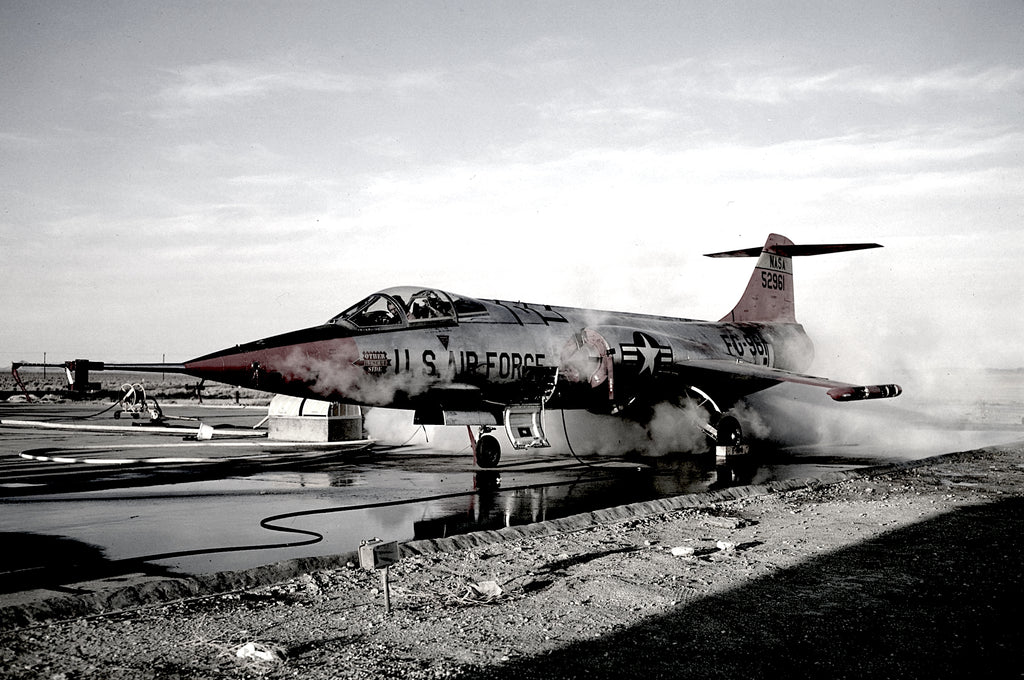


Passing through 70,000 feet in altitude and climbing over twice the speed of sound, Yeager was advised by ground control that his climb profile was a little shallow. To correct, Yeager applied the reaction control system to get back on the climb profile. Neither the RCS nor the flight controls would respond to Yeager's inputs…and the Starfighter, now on a ballistic path, entered a violent spin.

As the Starfighter tumbled towards the surface, Yeager pulled the ejection handle and left the out-of-control rocket plane as it twisted and rolled along all its axes.
The F-104 slammed into the desert floor, with Yeager landing nearby. He was still intact but unfortunately burned after his parachute deployed. Yeager had been inadvertently struck in the face by the base of his ejection seat, breaking his helmet’s visor and allowing burning residue from the rocket to enter the pure O2 environment inside his helmet. This sequence of events actually ignited a flame inside his visor, causing Yeager to suffer multiple burns to his face and hands. Moments after touching down under his canopy, a helicopter and flight surgeon arrived, and thankfully, Yeager survived to fly another day...
Although Yeager survived, the program did not, and many blamed Yeager for asking the aircraft to do things it was never meant to do that day. Amid accusations of improper checklists and aircraft procedures, contrary to Yeager's claims that the NF-104 was not fit for flight, other test pilots, like Apollo astronaut Frank Borman, directly blamed Yeager for the crash.




I think the 104 only has one burner to throttle down. 😁
I was at Edwards when the rockets where installed on the F-104’s. I left Edwards the first of November 1963. Was sad to learn of this tragedy.
I was an aircraft mechanic on NASA F-104/ 60748. I have photos by NASA of modifications for this X-15 pace/chase missions.
Nice!
Leave a comment