

Aviation Ghost Stories

Sometimes, the unmistakable sound of a lone Merlin engine fills the air in the dark of the night, during snowstorms, heavy showers, fog and in all seasons over residents near the former RAF station at Biggin Hill, Kent. Locals are very familiar with the sounds of the rare engine even though the base was shut down long ago. There have been countless reports over the years where witnesses claim to have heard, and even seen, a lone Spitfire flying overhead. Amazingly, some of these witnesses have been Wartime Veterans and pilots. Those of us who know the sound of a Merlin, know full well, it is not a sound to be mistaken for anything else. The question is not what engine is producing these sounds, the question is who is flying it.
According to past sightings, the Biggin Hill Spitfire is apparently seen around January, with the 19th your best chance to see the ghostly apparition in flight.

The Legend of Clubfoot
Location: Former Binbrook RAF base - Clubfoot was the unfortunate nickname given to an Australian who worked on Binbrook RAF airbase during the Second World War. For reasons unknown, Clubfoot attempted to sabotage a Royal Air Force Lancaster Bomber, and in doing so, somehow mistakenly blew himself up. The legend of Clubfoot grew over time due to what, or who, many believed to be Clubfoot, appearing during the dark hours time and time again for many years after his death walking around on the perimeter road of the old base.
To this day...the sightings continue.

Gremlins: Their origin is found in myths among airmen of multiple nations, many of whom claimed that gremlins were responsible for sabotaging their aircraft in flight.
The term "gremlin" denoting a mischievous creature that creates havoc on board aircraft, originated in Royal Air Force (RAF) slang in the 1920s among the British pilots stationed in Malta, the Middle East, and India, with the earliest recorded printed use being in a poem published in the journal Aeroplane in Malta on 10 April 1929. Some sources even indicate that reports go as far back as World War I
Scissor-wielding gremlins were known to cut the wires, sabotage engines, instruments, and antennae as well as the aircraft fuselage on poor unsuspecting pilots. These stories even being shared by Spitfire and Hurricane pilots during the Battle of Britain. Flight crews continued to blame gremlins for otherwise inexplicable accidents and incidents which sometimes occurred during their flights.
Gremlins were also thought at one point to have enemy sympathies, but further investigation revealed that Axis aircraft had similar and equally inexplicable mechanical problems. As such, gremlins were portrayed as being equal opportunity tricksters, taking no sides in the conflict, and acting out their mischief from their own self-interest.

The Cosford Aerospace Museum Haunting
There is a well-known and much talked about Avro Lincoln bomber located at the UK's Cosford Aerospace Museum. Over the years, there have been countless reported sightings of an apparition in and around the Lincoln aircraft, and most times, witnesses reported hearing perplexing sounds - some of which were apparently recorded during an overnight vigil inside the aircraft by a BBC reporter and a paranormal investigator.
During the course of the investigation, some of the sounds recorded by the BBC were played for some WW2 Veterans who actually piloted the Avro Lincoln Bomber. Much to the amazement of the investigators, the sounds were identified by ex-Lincoln RAF crews as those that would be caused by flight crews either going through the bombers pre-flight checks or during the course of a flight. The sequence, and timing of the sounds were precisely those that only a type-specific trained crew would have been able to perform.

There have been numerous reports from the former RAF Base, Montrose. A World War I trainee died while out on his first solo flight. Following the crash, his ghost was reported to have appeared in the base commander's room three times before the room was locked up by the military, and had not been used since. The ghostly crew member was also seen flying around in his biplane, up until the end of the Second World War.
A phantom RAF Officer was also seen around the base during the latter years of WW2. It was thought that he was killed when a mechanic with a grudge tampered with his aircraft's engine. The strange events continue to this day with continuous reports that an old radio set at the heritage centre continued to pick up Second World War transmissions, including Churchill's speeches


Astronaut Donald Deke K. Slayton (on right) and 1st Lt. Ed Steinman (on left) beside a Douglas A-26 bomber in the Pacific Theater of Operations during the summer of 1945. While the exact location is unknown, the photograph was most likely taken on Okinawa. 1st Lt. Slayton was one of only two NASA astronauts to fly combat missions during World War II.
Deke spent one year as a B-25 pilot with the 340th Bombardment Group, completing 56 combat missions. In 1944, he returned to the United States for a year before being assigned to Okinawa with the 319th Bombardment Group. As part of the first group to fly combat with the A-26 aircraft, he flew seven combat missions over Japan. Slayton logged more the 6,600 hours of flying time, including 5,100 in jet aircraft. He was named as one of the seven Mercury astronauts in April 1959 and was scheduled to pilot the Mercury-Atlas 7 mission, but a heart condition was discovered, sadly preventing him from moving forward in his astronaut training. He would not fly his mission.
While grounded, Slayton took several measures to attempt to be restored to flight status, including regularly exercising, vitamins, quitting smoking and coffee and reducing his consumption of alcoholic beverages. In 1970 his palpitations became more frequent and he started taking experimental daily doses of a crystalline alkaloid. This treatment was successful, but concerned that taking medication would still disqualify him from solo flying, Slayton stopped taking it against doctor's orders.
After a decade of seeing doctors around the world, and a long period without heart fibrillation, Deke was determined to not have a coronary condition. On March 13, 1972, NASA announced that Slayton had returned to flight status
Three years later, Deke climbed aboard a Saturn 1B rocket along with fellow astronauts, Brand, and Stafford. At 19:50:00, July 15, 1975 (UTC), the mighty Saturn 1B ignited her engines, sending Deke on his one and only space flight, as the Apollo docking module pilot. This flight marked the last manned flight before the Space Shuttle Program was launched.

While Deke never flew to space again, he remained with NASA until 1982 in a variety of capacities, from his involvement in testing the Space Shuttle Orbiter Enterprise, to modifications of several NASA Starfighters and Talons to help train the astronauts. While working on the Space Shuttle, Deke also assisted in developing the Space Shuttle Carrier Aircraft 747. Formally leaving NASA on February 27th, 1982.
In 1992, Slayton was diagnosed with a malignant brain tumour. On June 13, 1993, Deke flew west from his home in Texas from the illness, at the age of 69
He died at home at 3:22 a.m. on June 13, 1993, surrounded by his wife and daughter.
John Wayne Airport in California on June 13, 1993 at 7:57 a.m.. The unmistakably marked aircraft that Deke loved to fly...appeared in the skies above.

Deke's well-known bright red Williams W-17 Stinger racer, emblazoned with race numbers was a loud aircraft, that would draw attention to itself anytime it took to the sky. It was a beautiful aircraft, and Deke was proud of it.
That morning, the Stinger appeared unannounced in the skies above, and many surprised witnesses to the aircraft overhead were able to note both the registration and aircraft type.

As any pilot knows, many folks do not take kindly to the sounds of music aircraft produce, and as expected, due to local strictly enforced noise abatement regulations, the kind folks at the Federal Aviation Administration sent a letter of citation against the registered owner and pilot of the aircraft, stating that the noise level was above the allowed amounts. The family, upon receiving this letter, immediately contacted the FAA, and informed them of their error.
Firstly, at the time of the reported aircraft violation, Deke Slaton had already passed away at his home in Texas a few hours earlier.

Secondly, the aircraft that allegedly violated FAA regs, had already been placed on permanent display at an aircraft museum in Nevada, before the date of the flyover and, with its engine removed.
Nonetheless, the FAA had many witnesses in the incident. Certainly enough to proceed with further investigation. Witnesses were interrogated multiple times, by different agencies. None of them wavered in the identification of the aircraft.
That morning, the mysterious and still officially unidentified aircraft, performed a few maneuvers over the airport, then pulled up, into the clouds, never to be seen again.

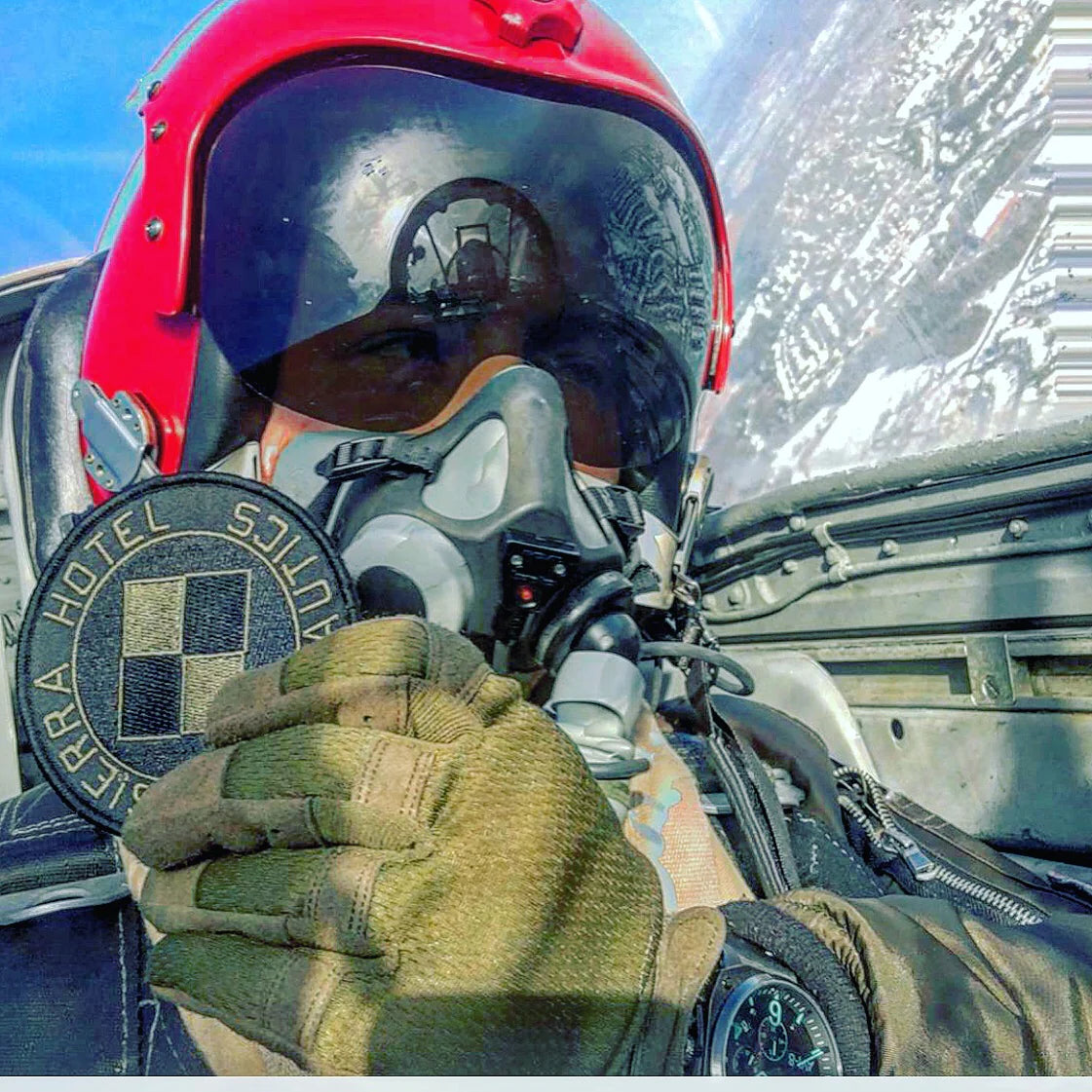
An aircraft is never still in darkness to those who listen intently past the drone of the engines; there is a whispering in distant chambers. There is something haunting in the light of the moon; it has all the dispassionateness of a disembodied soul and something of its inconceivable mystery. From all of us at Sierra Hotel Aeronautics...Eat, drink and be scary!



Leave a comment